Execution Capability for Digital Commerce

Data, AI &
Decisioning

Data becomes valuable when it enables better commercial decisions.

I connect Measurement, Customer Data, Analytics, Data Science and AI with the decision systems and digital products that turn them into concrete customer and business impact. Commercial Management remains the starting point: which customer, growth or resource decision needs to improve?

Building the Marketing Decisioning Capability at bonprix

From fragmented marketing steering to a marketing decisioning capability

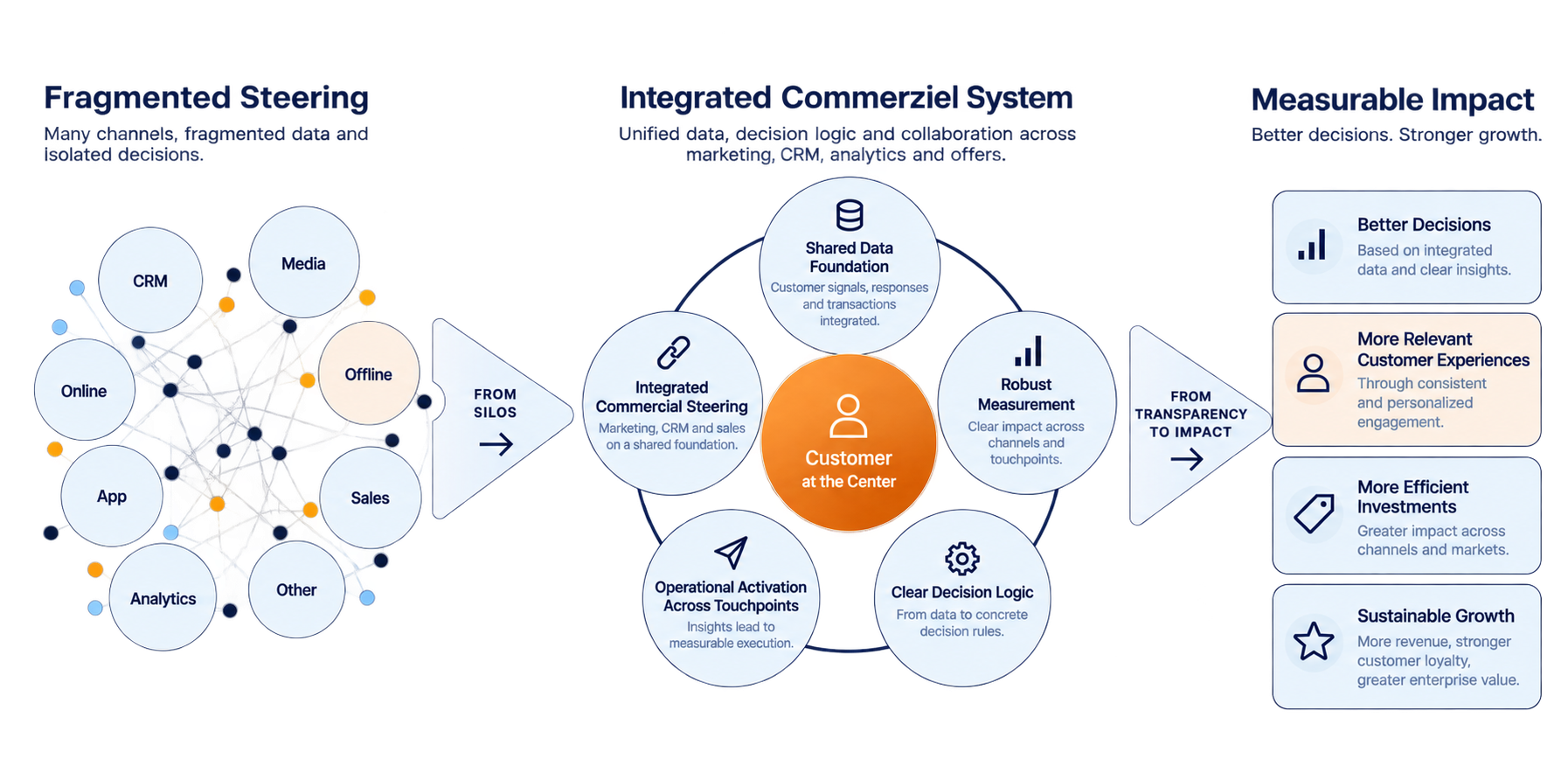
The transformation connected data, measurement, decision logic and organisation so that marketing could be steered as an integrated commercial system.
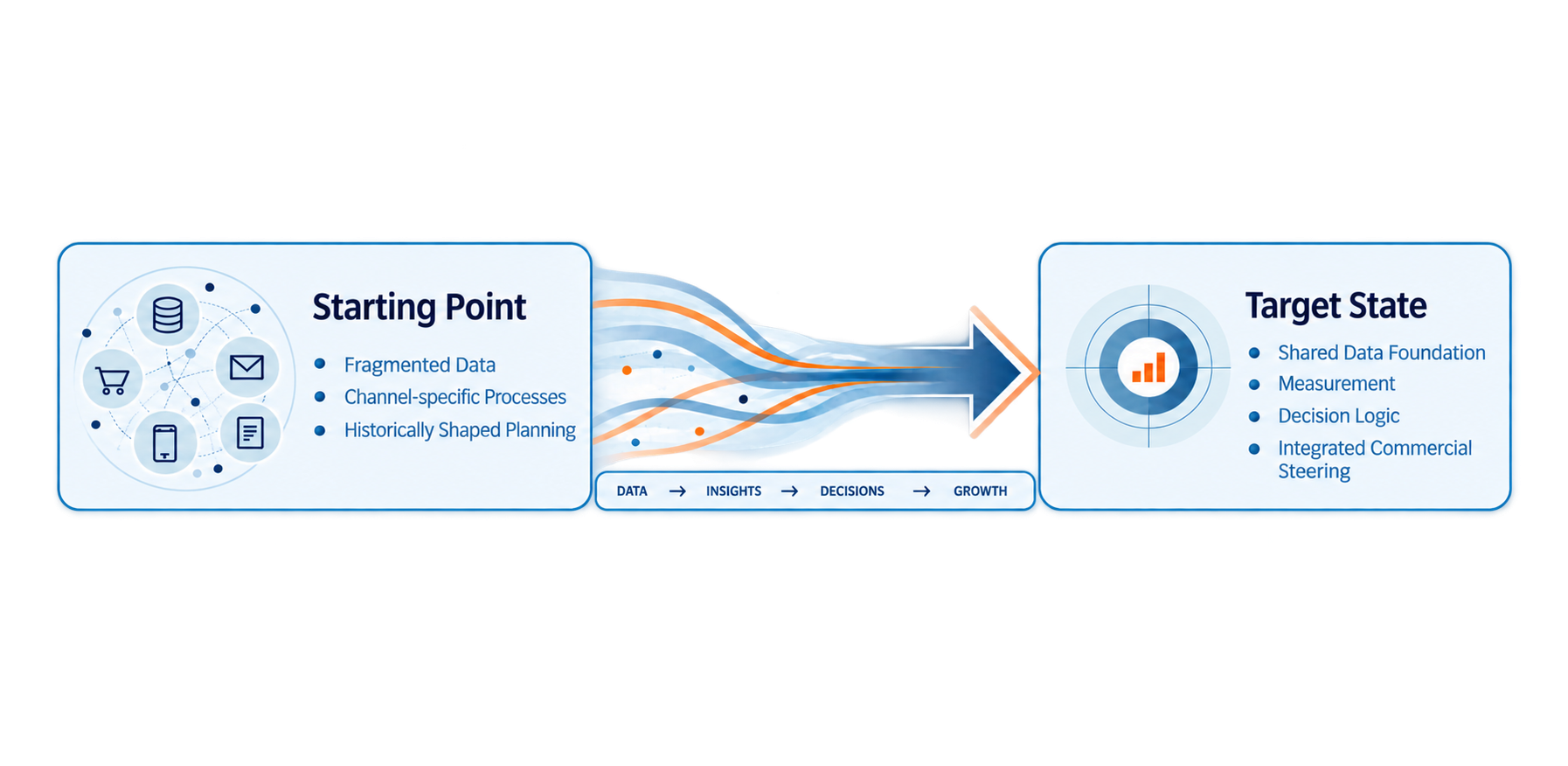
Transition from fragmented data, channel-specific processes and historically evolved planning to a shared data foundation, measurement, decision logic and integrated commercial steering.
From target state to implementation

Three building blocks turned it into a scalable marketing decisioning capability.
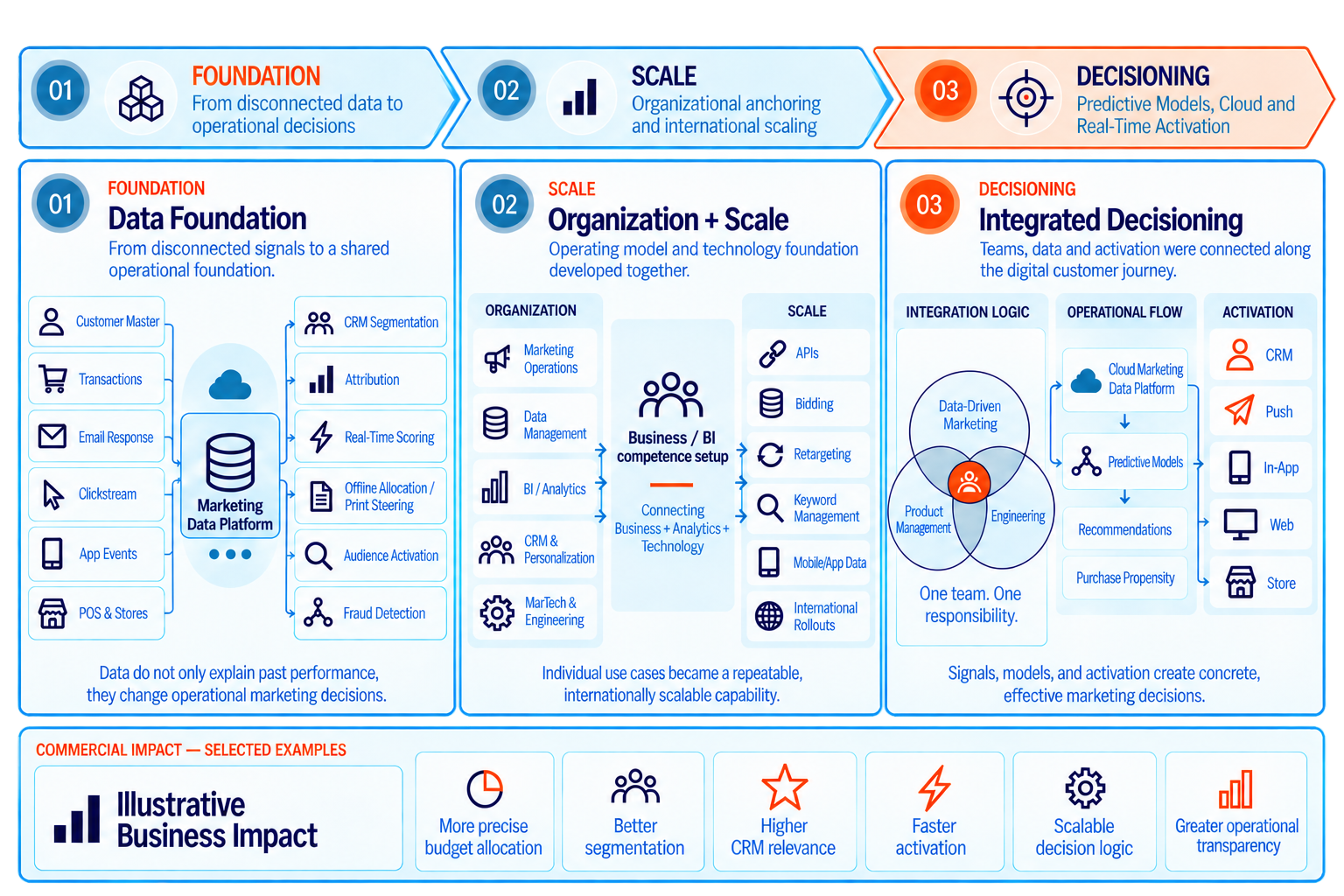
Foundation, scale and decisioning in detail

Marketing decisioning transformation overview: from a fragmented starting point through data foundation, organisation and scale, and integrated decisioning to selected business impact.
Starting Point → Target State

From fragmented steering to an integrated commercial system.

The starting point was separated data, channel-specific processes and historically evolved planning logic. The objective was not an isolated data project, but a shared decision foundation for marketing, CRM, analytics and activation.

Scroll horizontally or tap to open the visual at full size.
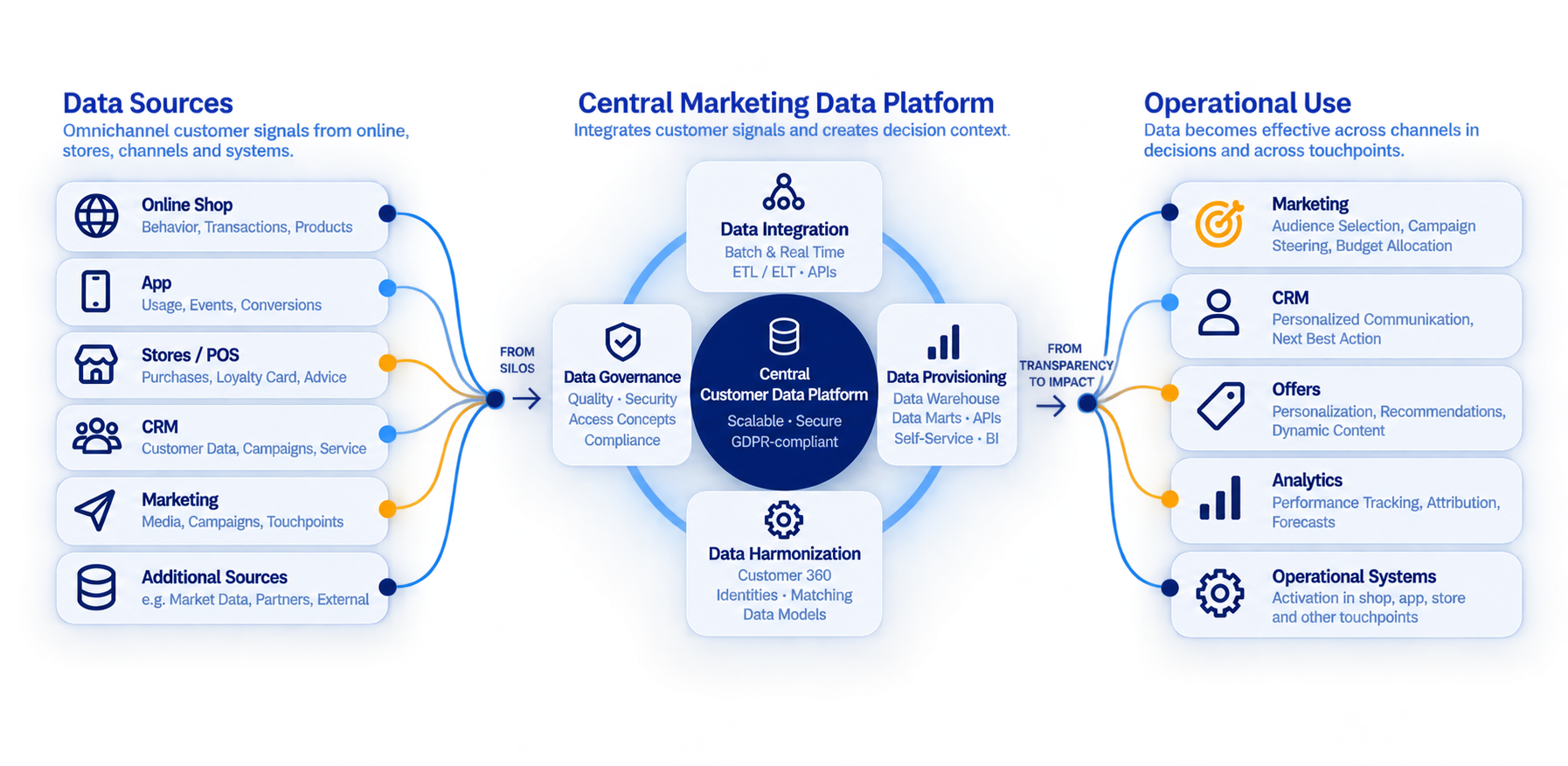
DATA FOUNDATION

From separated signals to a shared decision foundation.

The foundation was a platform logic that brought together customer signals, responses, transactions and behavioural data. The objective was not better transparency alone, but a robust foundation for operational marketing decisions.

Scroll horizontally or tap to open the visual at full size.
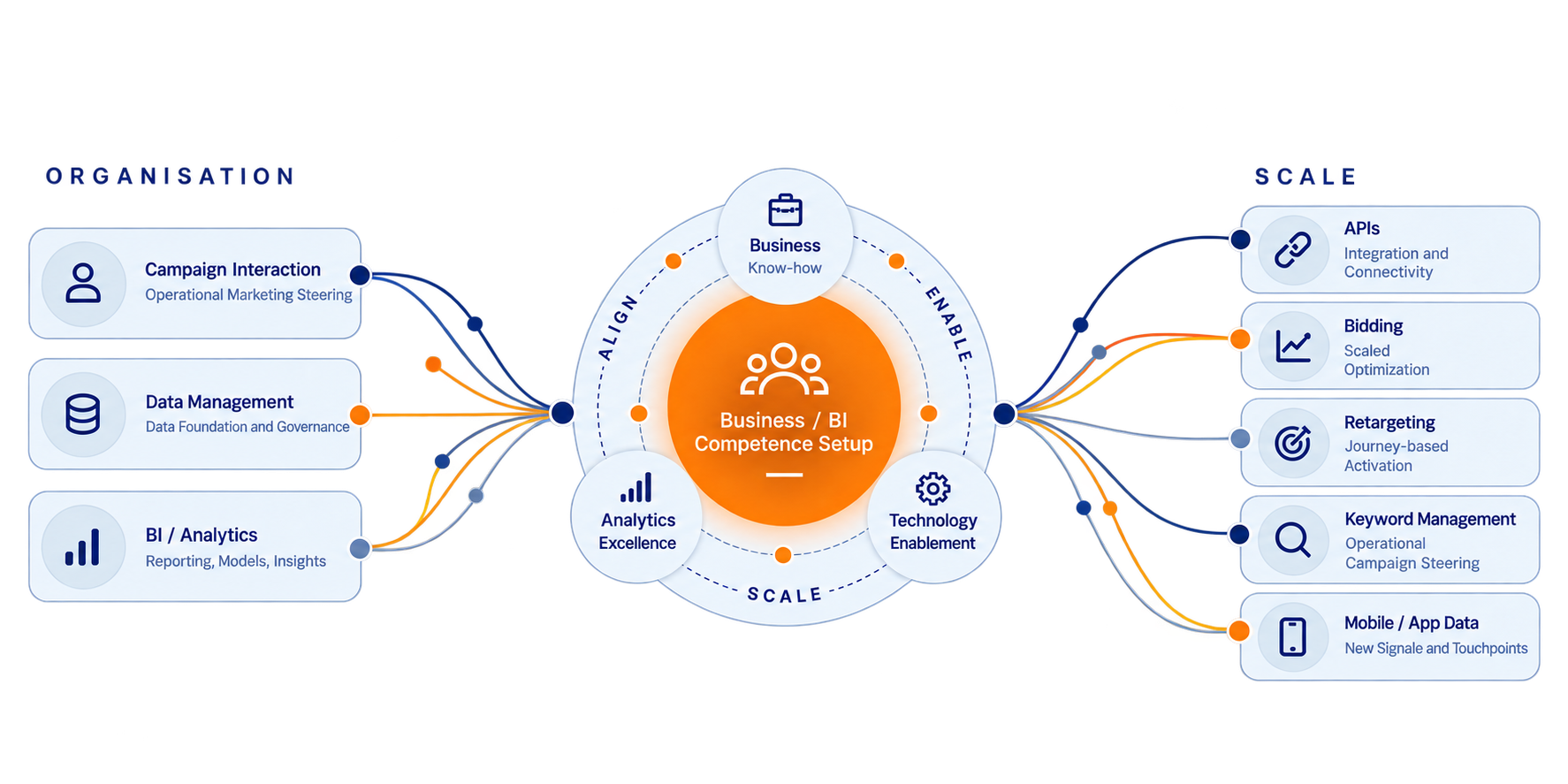
ORGANISATION + SCALE

Develop scalable capability from use cases.

Individual use cases gradually became a robust marketing decisioning capability: with clear roles, shared governance, an integrated data and technology foundation and repeatable mechanisms for international scaling.

Scroll horizontally or tap to open the visual at full size.
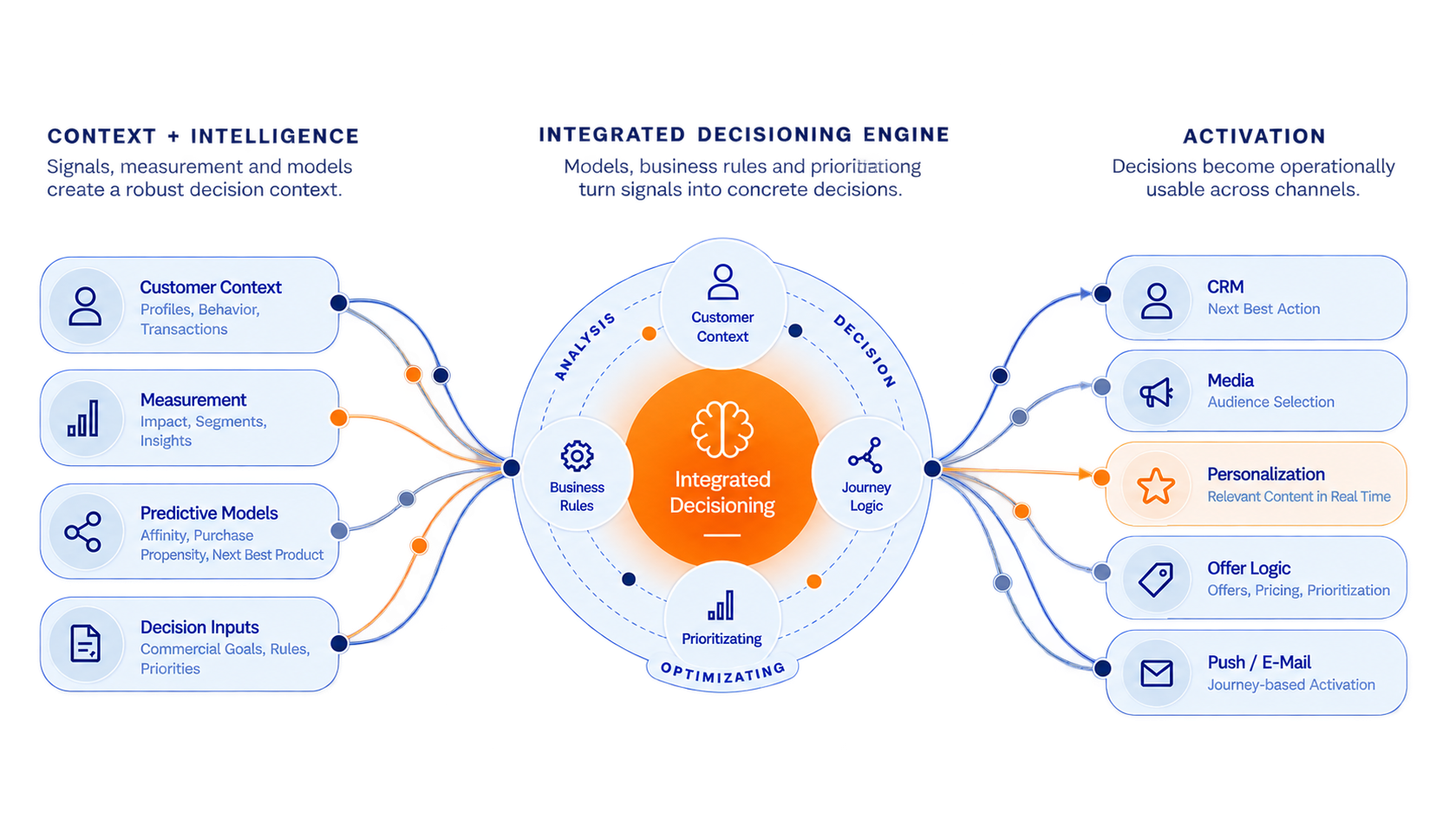
Integrated Decisioning

Connect data, decision logic and activation along the journey.

Data and models become concrete decision support for marketing, CRM, media steering and offer logic. The decisive factor is the seamless connection of insight, decision and activation in a closed learning loop.

Scroll horizontally or tap to open the visual at full size.
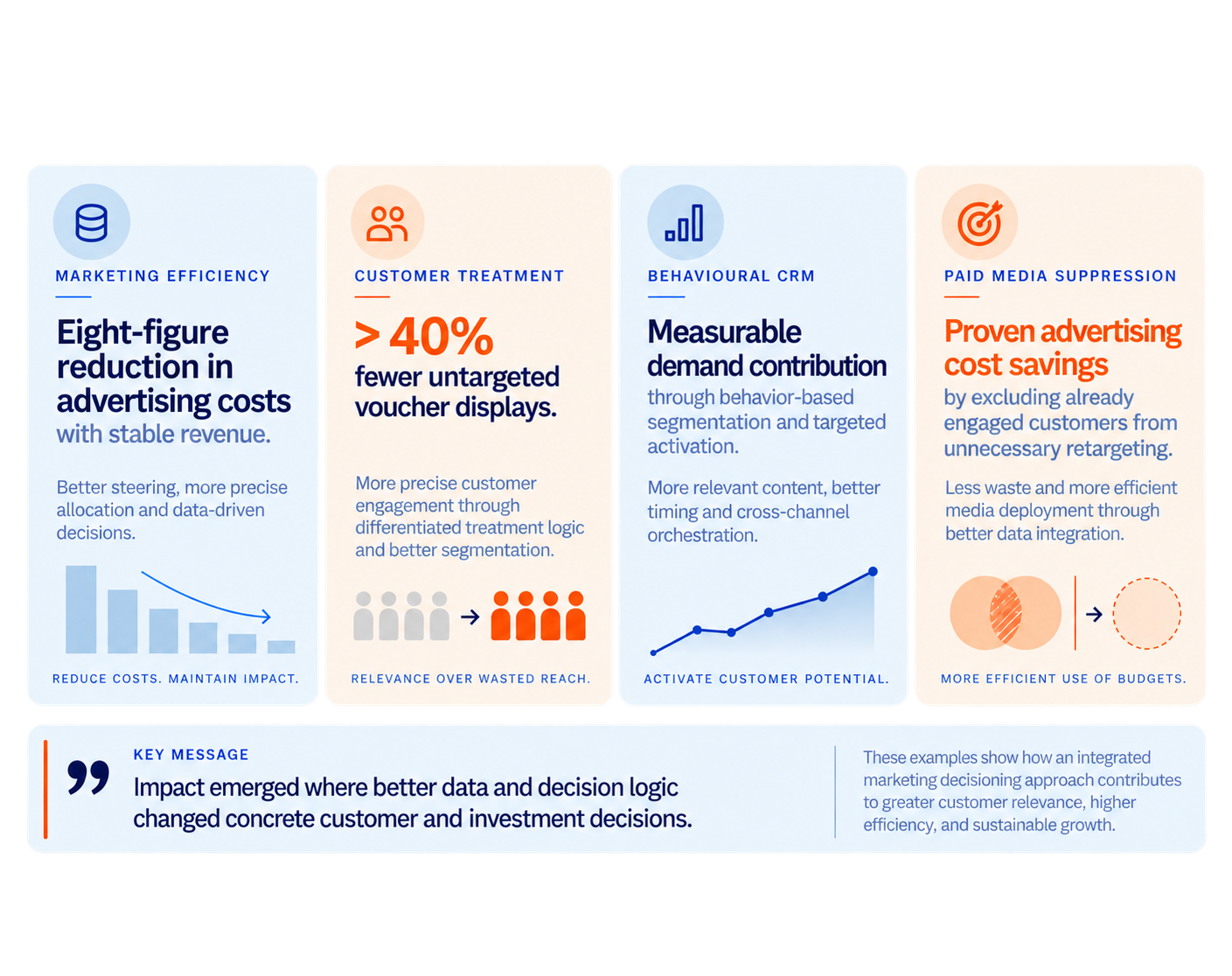
Commercial Impact · Selection

Examples of measurable business impact.

The capability operated across different decision areas. The following examples illustrate how data, decisioning and operational activation produced concrete economic contribution.

Scroll horizontally or tap to open the visual at full size.
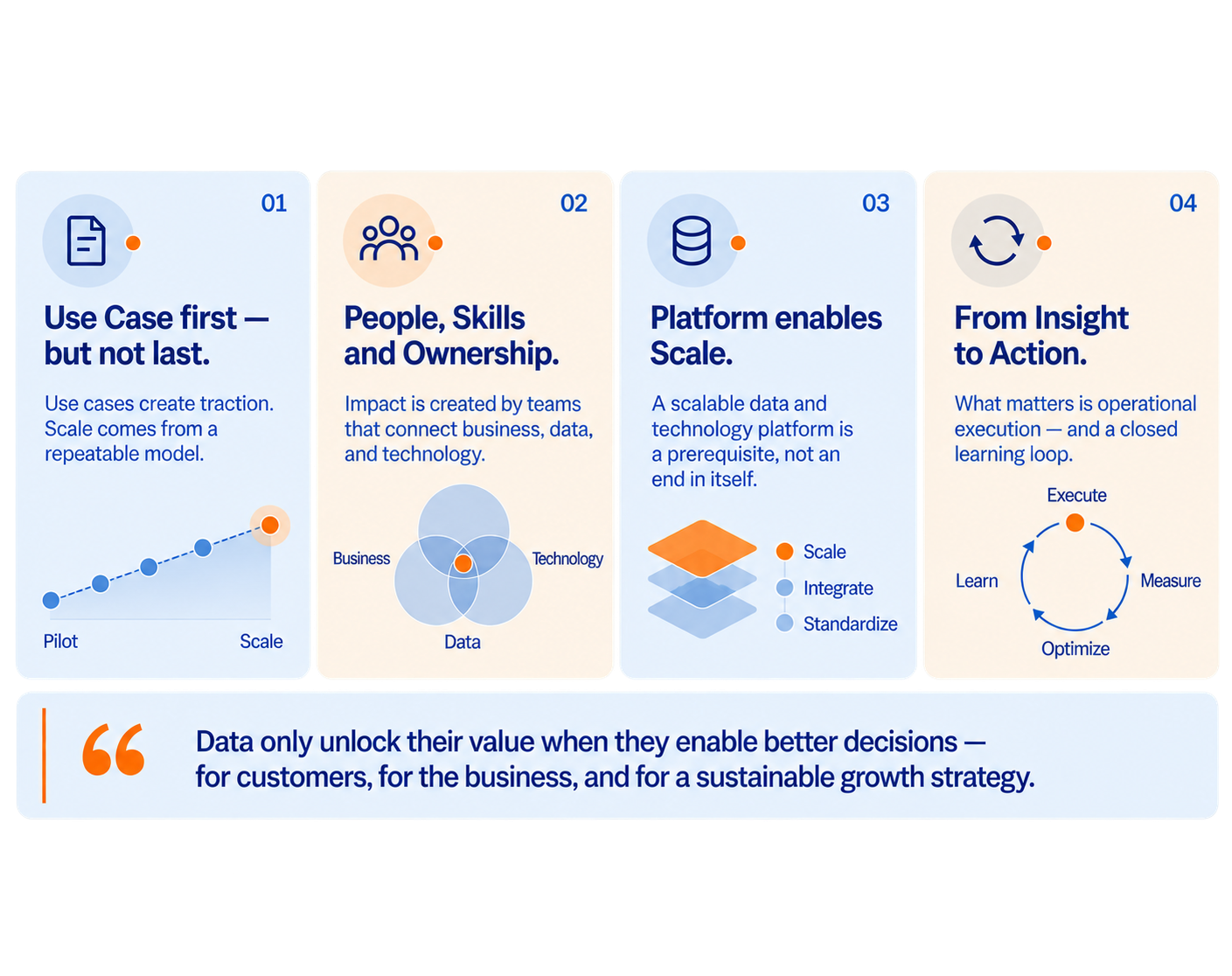
REALITY & LEARNING

What made the difference.

The real leverage emerged where data, decision logic, organisation and activation were designed together. Individual use cases became an effective, scalable capability.

Scroll horizontally or tap to open the visual at full size.
FULL CASE STORY · MARKETING DECISIONING

Building the Marketing Decisioning Capability

From fragmented, historically evolved marketing steering to integrated, data- and AI-enabled steering

Starting point: marketing decisions were constrained by fragmented data, channel-specific processes and historically evolved planning. Customer-level steering, cross-channel optimisation and systematic impact measurement were therefore possible only to a limited extent.

The objective was not another analytics tool, but to build the data, decisioning and organisational capabilities required to steer marketing as an integrated commercial system.

1. From separated data to operational decisions | 2015

I first initiated a structured maturity assessment to bring fragmented initiatives into a shared target state for data-driven marketing, set the direction for a common marketing data foundation and prioritise the first use cases.

We then established a central platform that brought together customer master and transaction data, email response data and web clickstream behaviour for the first time. Daily integration routines replaced separated data views.

On this foundation, data fed directly into operational steering:

  • automated, more granular CRM segmentation;
  • real-time scoring for use cases such as basket abandonment;
  • dynamic customer journey attribution to improve channel steering;
  • use of online engagement signals in offline customer scoring, improving catalogue allocation and reducing inefficient print spend.

The decisive shift was that customer data increasingly changed operational marketing decisions instead of merely explaining past performance.

2. Organisational anchoring and international scaling | 2016–2017

I established the organisational conditions for anchoring data-driven marketing as a sustainable capability rather than a series of isolated projects.

This included specialised roles such as campaign interaction managers, data managers and BI analysts, plus a BI capability setup connecting business, analytics and technology.

At the same time, I drove international scaling:

  • rollout of the marketing platform and campaign management capabilities to further markets;
  • direct API connections between the data foundation and performance marketing tools for bidding, retargeting and keyword management;
  • extension of customer data capture to mobile and app interactions.

The programme thus developed from local use cases into a repeatable international marketing capability.

3. Real-time marketing and predictive decisioning | from 2018/2019

As VP, I drove the next stage: from data-driven marketing towards increasingly predictive, automated and near-real-time customer steering.

We migrated the marketing data platform to the cloud to enable larger data volumes, faster experiments and machine learning at industrial scale.

Among other things, we operationalised:

  • predictive models for recommendations, purchase propensity, customer lifetime value and churn;
  • integration of customer and situation scores into CRM, push, performance marketing audiences and onsite personalisation;
  • systematic testing, incrementality measurement and model retraining.

In parallel, I brought data-driven marketing, product management and engineering together organisationally and combined the teams along the digital customer journey under shared responsibility.

The transformation therefore progressed from data-supported marketing to an integrated customer decisioning system.

4. Commercial impact

Annual advertising spend was reduced by a double-digit million amount while revenue remained stable. This materially improved the cost-to-revenue ratio.

The effect became visible 18 to 24 months after the programme began and then recurred annually.

Underlying effects included:

  • more than 40% fewer untargeted voucher displays through more precise customer targeting;
  • measurable incremental demand contribution from behavioural email segmentation;
  • evidenced advertising cost savings by deliberately excluding already engaged email customers from unnecessary paid retargeting.

5. Balancing incremental performance and brand effects in marketing steering

One principle I had already pursued in my earlier digital marketing responsibility was moving away from evaluating channels primarily on short-term attributed revenue.

As our measurement capability matured, we increasingly complemented attribution with experiments, control groups and incrementality-led measurement. The objective was to distinguish true causal uplift from demand that would have occurred anyway.

This created a more robust foundation for marketing investment decisions and the ability to reduce inefficient contacts and unwanted promotional effects.

At the same time, I advocated considering longer-term brand effects alongside direct response, conversion and customer value.

The objective was not to force every brand investment into a short-term ROAS logic, but to understand how brand building, demand generation and performance marketing interact across the customer journey.

Allocate investment according to its incremental commercial contribution while balancing short-term performance with long-term brand impact.

6. What made the transformation difficult

Customer identity and data quality

Web, app and CRM used different identifiers. Cookie limitations reduced observability, while privacy requirements constrained how signals could be connected.

This directly affected model quality and consistent customer orchestration.

Bringing models into real marketing processes

Batch versus real-time scoring, latency requirements, interfaces between data and activation systems, and reliable model operations were central challenges.

The difficulty lay less in the model itself than in making it genuinely usable in daily marketing.

Changing decision behaviour and organisation

Marketing teams were accustomed to steering campaigns manually.

Predictive decisioning required trust in algorithmic recommendations, a willingness to relinquish parts of manual control, and systematic learning through experiments.

I therefore treated change management, transparency and organisational adoption as integral parts of the transformation.

7. Central learning

The most difficult part of an AI transformation was not the machine learning model.

It was changing the data foundation, marketing systems and surrounding decision processes so that AI could reliably influence real commercial decisions.

Current AI explorations

Current spaces for learning and application — with maturity made explicit.

This work demonstrates architecture, methods and active learning. It deliberately does not carry the same level of evidence as the enterprise experience.

Prototype

Augur / sem-agentic

AI-assisted SEM decisioning with LLMs, rules, tools, evals and human approval. Architecture and evaluation are evidenced; autonomous production impact is not.

Explore
Prototype · synthetic data

Signal Steering

Measurement and Decision Intelligence through triangulation of attribution, geo-incrementality and MMM. Signal Steering is explicitly not an agentic system.

Explore
Active personal use

KA-OS

AI-enabled knowledge and context system for robust, longer-term human-AI work. Active personal use, not an enterprise-scale claim.

The 8 capability fields

From robust signals to reliable, scalable automation.

Introduction

Management Questions

    Principles

      Selected Evidence

      Principles

      Technology follows the decision question.

      1. 01Start with the decision, not the technology.
      2. 02Use the simplest mechanism that solves the problem.
      3. 03Evidence over plausibility.
      4. 04Intelligence creates value only through action.
      5. 05Reliability must scale with automation.
      Built & scaled at enterprise level

      Substance from operational accountability and scale.

      The established experience lies in building integrated Data, Analytics and Decisioning capabilities for an international Digital Commerce business.

      Integrated customer & marketing data platform

      Connected web, customer, transaction and marketing data as a shared foundation for analytics and steering.

      Data Science & predictive use cases

      Developed scoring, forecasting models and Data Science applications from validation through to operational use.

      Recommendation, Ranking & Personalisation

      Connected Search & Browse ranking, recommendations and real-time Personalisation with digital customer journeys.

      Cross-channel decisioning

      Used customer state and response signals for coordinated decisions across CRM, Paid Media and Onsite.

      BigQuery / GCP transformation

      Developed an established BI and data landscape towards a cloud-based analytics and data platform.

      Contact