Scope summary sem-agentic. Google Ads budget runs efficiently only when campaign steering and impact measurement work together. Augur is the working proof for the steering side. Evidence-backed: Agentic SEM system as a running pilot. Validation per agent and coordinated consolidation. Documented evaluation (ADRs, evaluation framework, audit). Not evidenced: Autonomous live operation. Impact at scale. Performance foundation partly synthetic. Execution in early rollout stages under human control.
sem-agentic
Google Ads budget runs efficiently only when campaign steering and impact measurement work together. Augur is the working proof for the steering side.
- Objective
-
Google Ads budget delivers only when campaign steering and impact measurement work together.
Augur is the working proof for the steering side: a multi-agent system that maps keyword strategy, performance analysis and budget-relevant recommendations for a Google SEM campaign end to end — with the same measurement discipline that signal-steering demonstrates on the evaluation side.
- Approach
-
Five validated agents, a coordinator with self-checking and a staged rollout.
Each agent produces reasoned proposals and is checked in a way suited to its output: shadow log and human review, LLM-as-a-judge or hypothesis tests. A strategy coordinator consolidates the results into a traceable recommendation. Deterministic logic where the rules are clear; an LLM only where it adds value. Execution progresses in stages: Shadow → Sandbox → Limited Live → Autonomous.
- Build vs. Buy
-
Introduce risk controls before autonomy instead of buying blindly or building without validation.
The simulation/production mode switch and five-stage rollout model (shadow analysis → shadow implementation → sandbox → limited live activation → autonomous operation) are the architectural answer to this question. Stages 1–2 are implemented; 3–5 are documented extension points, not live operation. Which proposals are adopted and from which stage an agent may act autonomously remains a deliberate human decision.
Evidence-backed
- Agentic SEM system as a running pilot
- Validation per agent and coordinated consolidation
- Documented evaluation (ADRs, evaluation framework, audit)
Not evidenced · out of scope
- Autonomous live operation
- Impact at scale
- Performance foundation partly synthetic
- Execution in early rollout stages under human control
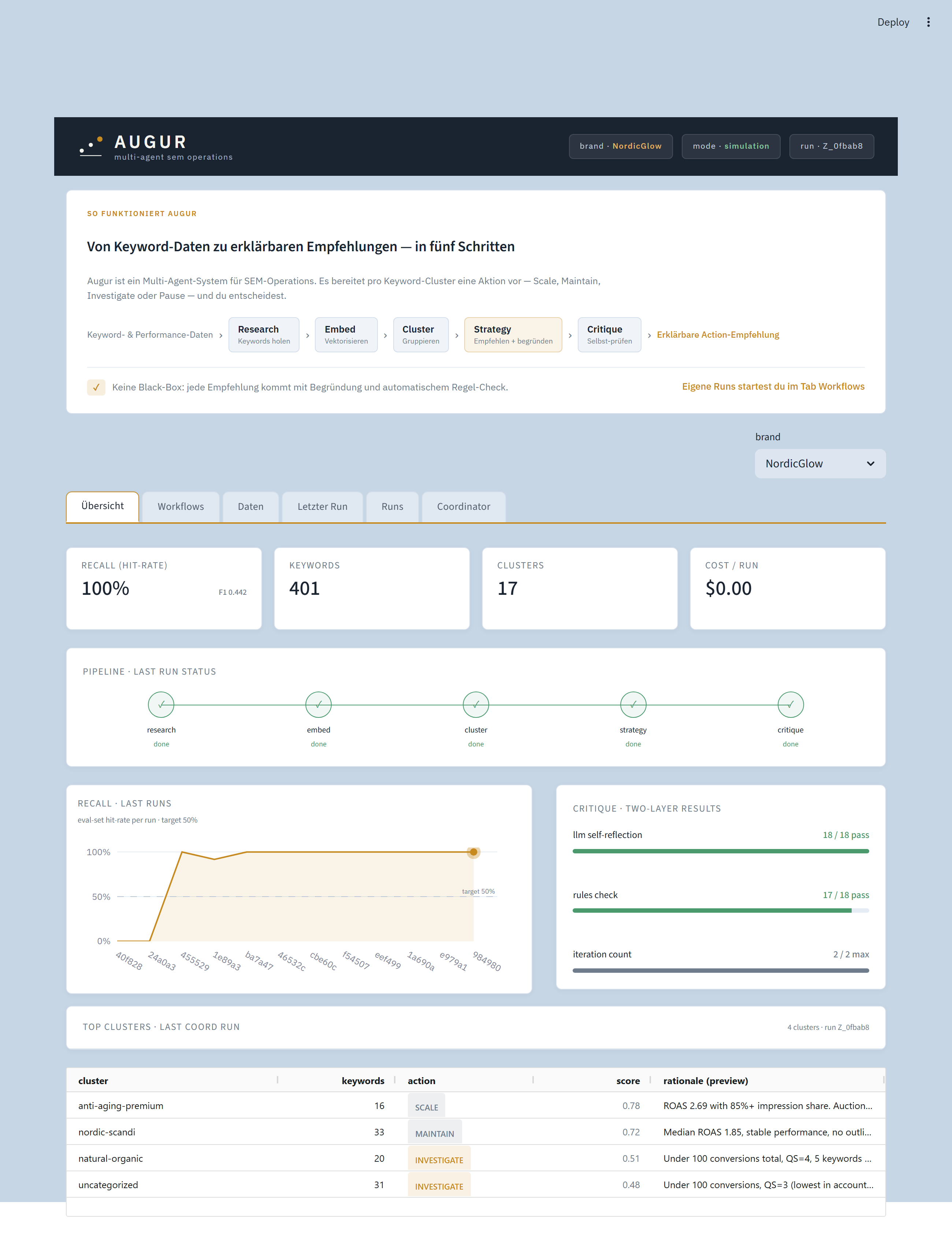
Multi-agent system with staged validation
Five specialised agents produce reasoned proposals. Each agent passes through a validation layer suited to its output. The strategy coordinator consolidates the results, with self-checking, into an auditable recommendation.
The simulation/production mode switch and five-stage rollout model (shadow analysis → shadow implementation → sandbox test → limited live activation → autonomous operation) are not incidental. They are the architectural answer to a leadership question: when should you buy a finished solution, when should you build, and how much autonomy must a system earn before moving real budget? Stages 1–2 are implemented (the agent analyses, a human reviews); stages 3–5 are documented extension points, not live operation. This risk-before-autonomy logic is transferable, whether Augur itself or a third-party solution is used in the end.
llm_overrides.v2026_05.yaml), versioned, with custom overrides available.Augur
secured deterministically
on its own
The performance analyst agent uses hypothesis testing against backtesting data — the same logic as incrementality-led budget steering, but at campaign rather than channel level. For a marketing organisation, this means Google Ads campaigns can be steered in a structured, auditable way before an agent is ever allowed to decide autonomously. The system can generate proposals. Which proposal is adopted, and how much autonomy it earns, remains a guided human decision.
How I work with AI tools as a leader: AI engineering practice →