Commercial Management · CRM · Customer Value
Integrated CRM & Customer Value
Developing customer relationships economically.
CRM means more to me than customer communications and campaigns. What matters is how a company develops its customer base: Which customers do we acquire? Whom do we want to retain or win back? Where is additional investment worthwhile – and where would it be unnecessary?
Customer knowledge and economic decisions must therefore come together across Marketing, CRM, Commerce and other customer touchpoints.
Not every channel should optimise for itself. What matters is what makes sense for the customer relationship and the business as a whole.
01 · Building the foundation
From data foundation to operational customer steering.
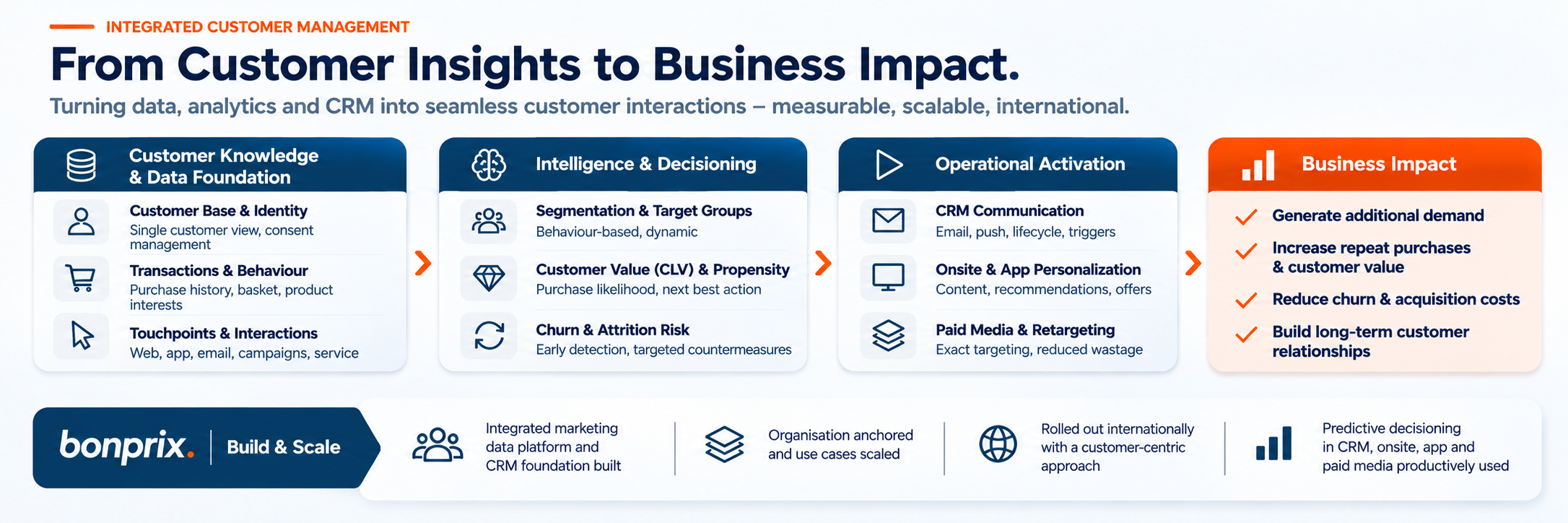
At bonprix, I played a major role in building integrated customer steering across several stages of development.
The starting point was a fragmented data and marketing landscape. Customer records, transactions, email responses and web behaviour sat in separate systems, while channels often followed their own steering logic.
As project lead, I led the cross-functional delivery and contributed directly to the data model, architecture decisions, target state and prioritisation of the first use cases.
The platform connected campaign management, real-time personalisation and analytics. Shop, app and Paid Media followed, together with predictive approaches for purchase propensity, customer value, churn and recommendations.
- FoundationConnect customer, transactional and behavioural data
- ActivationOperationalise segmentation and personalisation
- IntegrationLink CRM, shop, app and Paid Media
- Further developmentMake Predictive Decisioning usable internationally
02 · Operational practice
Three mechanisms that changed decisions.
Behaviour-based email segmentation
Current signals such as basket abandonment, product interest or recent interactions supplemented historical customer segments. This made it possible to respond more specifically to each customer situation.
Retargeting exclusions and avoiding unnecessary contacts
CRM and response information became usable for Paid Media. Customers who had already engaged or purchased could be excluded deliberately instead of buying further paid contacts unnecessarily.
Predictive Decisioning in CRM, newsletters, push and onsite
Purchase propensity, customer value, churn and product recommendations were integrated into CRM, newsletters, push and onsite. A model only delivered value when its score changed a real decision at the right time.
03 · Real challenges
The difficult parts lay between data, operations and organisation.
- Identity
- Different identifiers, cookie constraints and privacy requirements limited which customer signals could be connected reliably.
- Operationalisation
- Batch processing, real-time capability, interfaces and stable operations determined whether a score was available at the relevant moment.
- Adoption
- Teams had to complement fixed campaign logic with hypotheses, experiments and model-assisted decisions. Clear accountability and visible results were central to this.
04 · My contribution
Connecting economic logic, data and customer interaction.
I played a major role in building integrated customer steering at bonprix – from a shared customer understanding and the first marketing data platform to internationally scaled, data- and AI-enabled customer steering.
In doing so, I shaped the economic, domain and technological development:
- 01Built CRM capabilitiesand focused customer development more strongly on repeat purchase, customer value and economics.
- 02Co-designed the data foundation and architectureincluding the customer model, integration of touchpoints and prioritisation of the first use cases.
- 03Connected CRM, Marketing and Commerceso customer signals flowed directly into communication, personalisation and customer interactions.
- 04Established and scaled new capabilitiesfrom behaviour-based segmentation to Predictive Decisioning and international use.
05 · Implication
Do not start with the platform.
First clarify how the customer base develops economically, which decisions are not good enough today and where a change will make the greatest difference. Then start with a small number of use cases, test the impact and scale successful solutions systematically.
A shared data foundation is necessary. It only becomes decisive when people and systems use it to make better decisions together.